Google Is Making AI Search Links More Visible. Here's What It Means for Brands.
Summarize with AI
Opens your chosen AI platform in a new tab. Sign-in may be required; article access and summaries vary by platform.
Key Insights
- Google's October 15, 2026 announcement describes five AI search link presentation changes with different rollout and testing statuses.
- More inline links and related-article presentation changes should not be confused with guaranteed traffic or ranking improvements.
- The official-page section and clickable creator and publisher names are tests, not universally available placements.
- Brands should coordinate accurate owned content, expert identity, technical accessibility and relevant cross-channel evidence.
- Measure brand mentions, linked citations, citation prominence, referrals and qualified conversions separately.
- A 30-day plan should establish a baseline, repair priority pages, connect channels and evaluate outcomes without claiming causation.
An AI answer can mention your brand, use your website as evidence and still give the reader little reason to visit. That gap between being present and being chosen is where executive teams need to focus.
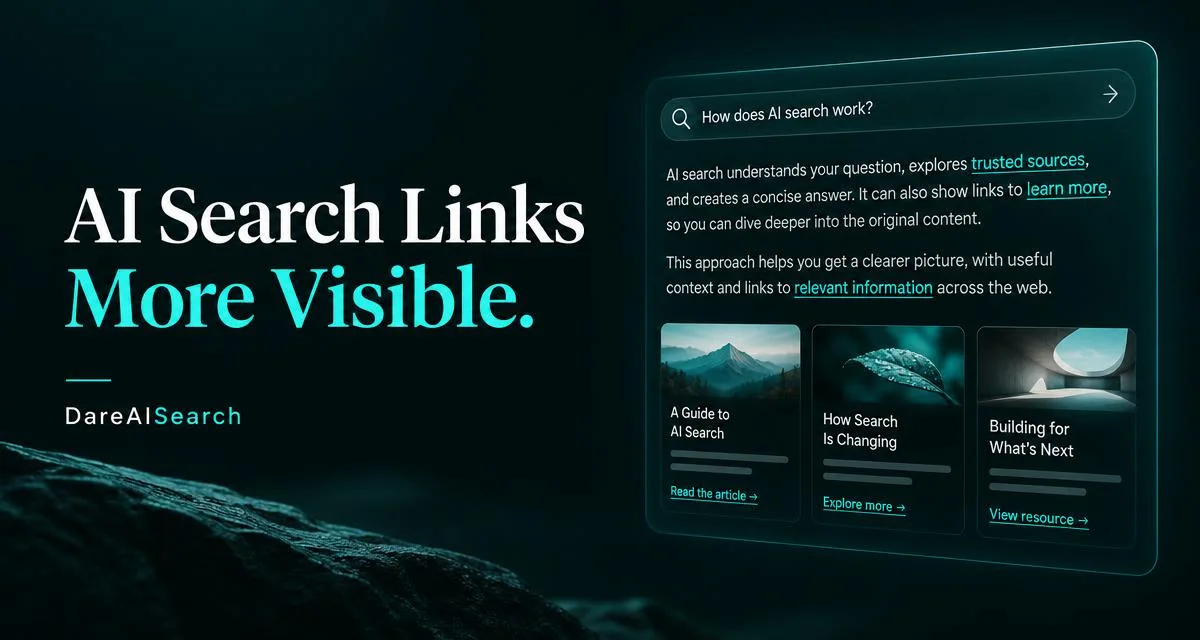
On October 15, 2026, Google announced changes intended to make web links more visible across AI Mode and AI Overviews. The update creates new possibilities for discovery, but it is not a promise of more traffic. A visible link only becomes commercially useful when it connects a relevant question to a credible destination and a meaningful next step.
For brands, the strategic question is not simply, “Are we appearing in AI answers?” It is, “Where do we appear, what role do we play, and does that presence help the right customer move forward?”
What Google announced, and what remains a test
Google's primary announcement describes five changes with different release statuses. Treating them as one completed global launch would be misleading.
1. More inline links, appearing higher in answers
Google says it has increased inline links in its AI experiences and is launching changes to show them higher in responses more frequently. This concerns the placement of links within the answer, not just a separate source list.
The brand implication is specific: a page should offer evidence that supports a particular statement or decision. Clear product specifications, original analysis and well-supported explanations give readers something useful to investigate. This is a content-quality priority, not an announced new ranking formula.
2. A prominent official-page section
Google says it will test a dedicated section at the top of responses for specific official pages, with context explaining why the links may help. This is a planned test, not a universally available official-site slot.
Brands should check whether their own destinations genuinely resolve important questions. Can a prospective customer find the current product, location, eligibility conditions or service details without navigating conflicting pages? An “official” destination still needs to be useful. The announcement does not describe a way to buy or guarantee inclusion.
3. Timely-article carousels expanding further
Google is starting to roll out carousels for timely articles to additional locations and languages globally. These can highlight a user's Preferred Sources. The expansion language applies to this feature, not automatically to every item in the announcement.
This matters for publishers and brands with substantive, timely expertise. Publish when there is a real development to explain, identify what changed and distinguish reporting from interpretation. Recycling headlines without adding evidence is not a durable editorial strategy.
4. More prominent related articles
Google is making links at the end of some AI responses more engaging through image thumbnails and a more clickable design. “Some” matters: brands should not assume the same presentation for every query.
Related reading needs to deliver depth beyond the answer itself. A useful comparison, implementation guide or research explanation can justify the next click. Accurate titles and representative images help readers assess relevance, but neither is evidence of guaranteed selection or increased traffic.
5. Clickable creator and publisher identities
Google says it started testing links from names on video results to their associated Search profiles in AI Mode during the announcement week. This is an identity-link experiment, not a blanket rollout across all formats.
For brands, expert identity deserves operational attention. Keep author names, credentials and publisher information consistent across the website and video channels. Our analysis of Search Profiles and Preferred Sources explores the broader discovery implications.
The strategic shift: visibility has a location
The useful distinction is between being included and being presented where a reader can act. A brand named deep in an answer, a citation beside a relevant claim and an official-page link near the top are different exposures.
Teams should therefore stop treating a single “AI visibility” score as the whole commercial story. A mention may establish awareness without sending traffic. A prominent citation may invite inspection without producing a qualified lead. A referral may come from someone researching, not buying.
Google supplies no performance results for these five changes and no universal availability schedule. More prominent links could make exploration easier, but the effect on clicks remains something to measure. These are presentation changes, not evidence that a brand's rankings have improved.
The practical response is coordinated execution: technical accessibility, useful owned content, credible third-party coverage and clear expert identity. These channels reinforce the information a customer encounters, without guaranteeing an AI system's choices.
A practical 30-day action plan
Days 1-7: establish the baseline
Select a stable set of commercially relevant questions across discovery, comparison and purchase readiness. Include the questions sales teams actually hear. Record query wording, date, market, device and whether you observed AI Mode or AI Overviews.
Capture screenshots and destination URLs. Note mentions, linked citations, placement and competing brands separately. Identify existing landing pages and establish their current organic traffic and qualified conversion baseline. Assign one accountable owner across marketing, content, technical and analytics teams.
Days 8-14: repair the evidence layer
Audit priority pages for factual accuracy, crawlability and a clear answer to the customer's question. Consolidate contradictory descriptions. Make product details, service scope, author information and update dates easy to verify.
Improve the pages that already serve high-intent questions before producing more content. Add genuine examples, documented expertise and clear limitations. Link supporting resources internally. Do not invent research or add schema that misrepresents the page.
Days 15-21: connect channels and destinations
Publish useful commentary only where the brand has something substantive to add. Align website explanations, expert videos and relevant third-party profiles around consistent facts, while respecting each channel's audience.
Check that a reader arriving from a citation reaches the promised answer immediately. Give them a context-appropriate next step, such as a detailed comparison or a qualified consultation. A generic sales interruption can waste a relevant visit.
Days 22-30: evaluate and prioritize
Repeat the baseline questions under comparable conditions. Document interface variation instead of averaging it away. Review visibility alongside traffic quality and sales feedback.
Prioritize improvements that address an observed gap: missing evidence, a weak destination, inaccurate identity information or a poor conversion path. Keep a change log so the team can distinguish its work from Google's evolving interface. A month establishes a disciplined cycle, not proof of causation.
Measure five outcomes, not one score
Brand mentions: Track whether the brand is named and in what context. Separate a recommendation from a passing reference or negative comparison. A mention is not a link.
Linked citations: Record links to owned pages separately from third-party pages mentioning the brand. Capture the destination and the claim it supports. Do not count an unlinked name as a citation.
Citation prominence: Describe placement consistently: inline near the opening, later inline, a dedicated section or related reading at the end. Record device and surface. Treat this as an observation, not an invented Google metric.
Referrals: Use analytics and landing-page evidence to assess attributable visits. Google AI traffic may not be cleanly separable in every reporting view. Label identifiable traffic, broader Google organic traffic and unknown attribution honestly; do not infer sessions from screenshots.
Qualified conversions: Agree with sales on what qualifies, then measure relevant enquiries and downstream opportunities where consented attribution supports the connection. More sessions alone do not establish commercial value.
Our CMO measurement framework provides additional context. Google's separate website-owner guidance discusses controls and reporting developments; it should not be mistaken for universal reporting availability for the October changes.
From monitoring to managed execution
DareAISearch is an end-to-end managed AI discovery solution. Experts and agents execute across channels, connecting research, technical priorities, content, authority development and measurement. Monitoring informs that work; it is not the entire service.
For executive teams, the goal is an accountable operating rhythm around credible discovery and qualified demand, not another dashboard disconnected from delivery. Book a qualified DareAISearch demo with your website, priority markets and commercial objectives. We can discuss the gaps worth investigating and the execution needed, without promising rankings, citations or clicks.
One Unified Engine for GEO and SEO.
Book A DemoWant to create your own llms.txt file?
Use the free DareAISearch llms.txt Generator to create an upload-ready file for your website in minutes.
Frequently Asked Questions
Are all five Google AI search link changes fully rolled out?
Will more prominent AI search links automatically increase clicks?
How should brands distinguish mentions from citations?
What should a brand do first?
Is DareAISearch only a monitoring dashboard?
Related Reads
OpenAI Introduces Businesses in ChatGPT: What Brands Should Do Next
9 min readAI SearchFestive Shopping Is Becoming AI-Led: What Indian D2C Brands Should Do Now
13 min readAI SearchGoogle Search Console Can Now Measure Multimodal Search: Why Visual Discovery Just Became a First-Class SEO Metric
8 min readAI SearchChatGPT Changed What It Cites: Why Building GEO Around Any One Source Is Dangerous
12 min readCheck Your AI Search Visibility
Find out how your brand appears across ChatGPT, Gemini, Perplexity, and Google AI Overviews.