ChatGPT Ads Manager Is Here: What OpenAI's Self-Serve Ad Platform Means for Brands
Summarize with AI
Opens your chosen AI platform in a new tab. Sign-in may be required; article access and summaries vary by platform.
Key Insights
- OpenAI launched a beta self-serve ChatGPT Ads Manager for US advertisers on May 5, 2026.
- The platform introduces CPC bidding, Conversions API, and pixel-based measurement for ChatGPT ads.
- Ads will be clearly labeled and kept separate from ChatGPT's organic answers.
- ChatGPT advertising is context-led rather than keyword-led, requiring a new approach.
- Paid AI visibility will not replace GEO; the strongest brands will combine organic AI mentions with paid placements.
- Brands should audit AI visibility, build prompt universes, strengthen authority, and prepare AI-native landing pages.
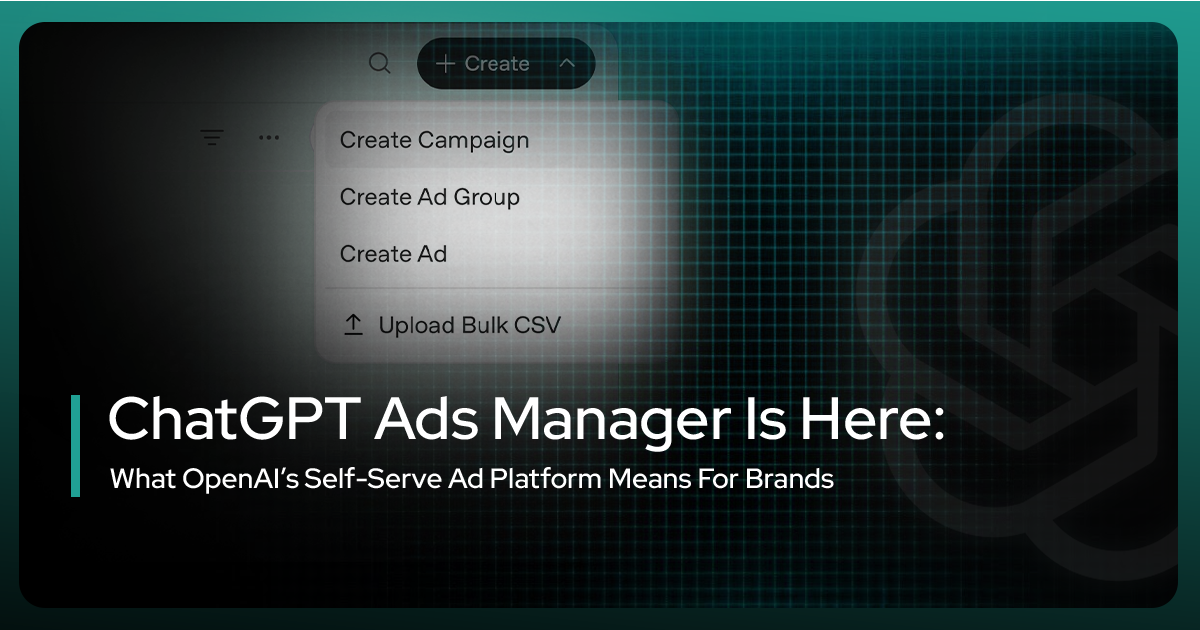
On May 5, 2026, OpenAI announced a major update to its ChatGPT advertising pilot: advertisers in the US can now sign up for a beta self-serve Ads Manager to run ads directly inside ChatGPT. This is not just another ad product launch. It is an important signal that AI search and conversational discovery are moving from an organic-only visibility layer to a full paid + organic marketing ecosystem.
For brands, this changes the question from:
"Are people finding us on ChatGPT?"
to:
"Are we visible, cited, recommended, and now advertised in the moments where users are actively making decisions?"
At DareAISearch, we believe this is one of the clearest signs yet that AI search visibility is becoming a serious marketing channel, not an experimental side project.
What OpenAI Announced
OpenAI has been testing ads in ChatGPT with a small set of advertisers. With the latest announcement, it is expanding the way businesses can buy and manage ChatGPT ad campaigns.
The key updates are:
- Beta self-serve Ads Manager
- CPC bidding
- Expanded measurement tools
- Partner-led buying through agencies and ad-tech platforms
- Clear separation between ChatGPT answers and sponsored ads
OpenAI says advertisers can now create campaigns through selected partners or through a new beta self-serve Ads Manager. The self-serve platform allows businesses to register as advertisers, add payment information, set budgets, upload ads, manage campaigns, and view performance directly from the portal.
The important part: this is currently being rolled out gradually for US advertisers as OpenAI continues to test and refine the experience.
Why This Matters
Search advertising changed the internet because it allowed brands to appear at the exact moment of intent.
ChatGPT ads could become important for a similar reason, but the intent layer is different.
In traditional search, a user types a keyword.
In ChatGPT, a user explains a problem, shares context, compares options, asks follow-up questions, and often moves closer to a decision within the same conversation.
OpenAI's Ads Manager page describes this as reaching people while they "explore options, compare choices, and make decisions." It also highlights that ChatGPT allows advertisers to go beyond keywords because users share richer context during conversations.
This is the key shift.
Brands are no longer competing only for search rankings. They are competing for decision visibility.
From Keywords to Context
For the last two decades, most paid search strategies were built around keywords.
A user searches:
- "best running shoes"
- "home loan interest rate"
- "best CRM for small business"
- "top skincare clinic in Dubai"
The brand bids on that keyword and tries to win the click.
But in ChatGPT, the query can look very different:
- "I am training for my first half marathon and need comfortable running shoes under ₹10,000. I have flat feet. What should I buy?"
- "I am planning to take a home loan in India. What should I compare before choosing a bank?"
- "We are a 20-person B2B SaaS startup. Which CRM should we use if our sales team is small?"
- "I am visiting Dubai and want a reliable skincare clinic for pigmentation treatment. What are my options?"
These are not just keywords. These are rich decision prompts.
That means the advertising system also needs to understand context, stage of intent, product fit, and the likely next action.
This is why ChatGPT ads are not just a new placement. They are a new kind of intent environment.
CPC Bidding Comes to ChatGPT Ads
OpenAI has also introduced cost-per-click bidding for ChatGPT ads.
Earlier, advertisers in the pilot could buy ads on a CPM basis. Now, with CPC bidding, advertisers can align spend more directly with user actions. OpenAI says advertisers are charged based on click outcomes under CPC bidding, while CPM buying will continue to be supported.
This is an important development because CPC makes the platform easier for performance marketers to test.
Most advertisers are more comfortable starting with:
- Clicks
- Cost per click
- Landing page visits
- Leads
- Sign-ups
- Purchases
rather than only impressions.
For early adopters, CPC bidding could make ChatGPT ads more measurable and easier to compare against Google Search, Meta, Reddit, LinkedIn, and other intent or discovery platforms.
Measurement Is Becoming a Core Part of ChatGPT Ads
OpenAI also announced that it has launched Conversions API and pixel-based measurement so advertisers can understand what happens after someone engages with an ad, such as a purchase, lead, sign-up, or other meaningful action.
This matters because without conversion tracking, ChatGPT ads would remain a brand-awareness experiment.
With conversion tracking, brands can start asking performance questions:
- Which prompts or contexts are driving clicks?
- Which categories are creating high-intent sessions?
- Which landing pages convert best from ChatGPT ad traffic?
- Are ChatGPT users researching more deeply before converting?
- Does ChatGPT assist conversion even when it is not the final click?
OpenAI says advertisers will receive aggregated performance insights and will not get access to individual conversations.
That privacy-first approach is important, but it also means marketers will need to rethink measurement. They may not get the same level of user-level detail they are used to from other platforms.
Ads Will Be Separate From ChatGPT Answers
One of the biggest concerns around ads in AI answers is trust.
If users believe sponsored content influences the actual answer, the product loses credibility.
OpenAI has directly addressed this by saying that ChatGPT's answers will remain independent, ads will not influence responses, and ads will be separate and clearly labeled. OpenAI also says conversations are kept private from advertisers and user data is not sold to advertisers.
This distinction is critical.
There will likely be two separate layers of visibility inside ChatGPT:
- Organic AI visibility — Where a brand is mentioned, cited, recommended, or included in the answer based on relevance, authority, content, and structured signals.
- Paid AI visibility — Where a brand appears as a clearly labeled sponsored placement based on ad targeting, bidding, and campaign setup.
For brands, both layers will matter.
The mistake would be to treat ChatGPT ads as a replacement for AI search optimization.
Paid visibility can help you show up.
Organic AI visibility can help you be trusted, cited, and chosen.
The strongest brands will build both.
Why This Is Bigger Than Just Another Ad Platform
When Meta launches a new placement, marketers test creative.
When Google launches a new campaign type, marketers test bidding and keywords.
But ChatGPT ads require a different kind of thinking.
This is not a feed.
This is not a search results page.
This is a conversational decision environment.
A user may start with research, move into comparison, ask for recommendations, evaluate trade-offs, and then click only when they are much more informed.
That means brands need to think about:
- Prompt-level intent
- Category education
- Organic mentions
- Competitive comparisons
- Landing page relevance
- Trust signals
- AI-readable content
- Third-party authority
- Reviews and citations
- Conversion paths after an AI-assisted click
In other words, ChatGPT ads sit at the intersection of paid media, SEO, GEO, CRO, content strategy, and brand authority.
What This Means for Different Types of Brands
For D2C and e-commerce brands
ChatGPT ads could become a powerful channel for product discovery and comparison-led buying.
A user may ask for:
- Best protein powders for beginners
- Best running shoes for flat feet
- Best skincare products for sensitive skin
- Best luggage brands for international travel
- Best smart rings for health tracking
In these journeys, the user is often not just browsing. They are seeking a recommendation.
For D2C brands, this creates a major opportunity to appear during high-intent consideration moments.
But the landing page experience will need to be sharper than ever. If the user arrives after a detailed ChatGPT conversation, generic product pages may not convert well. Brands will need pages that directly address comparison, objections, use cases, proof, and decision criteria.
For SaaS and B2B brands
ChatGPT is already becoming a research assistant for software decisions.
Users may ask:
- Best CRM for a small sales team
- Best project management tool for remote teams
- Best marketing analytics platform for a D2C brand
- Best customer support software for a startup
- Best AI search optimization platform for brands
For SaaS brands, ChatGPT ads could become an important channel for demand capture.
But the challenge will be different from Google Search.
In B2B, users often ask ChatGPT for a shortlist, comparison, pros and cons, or category explanation. If your brand is not organically understood or cited in the answer, a sponsored placement alone may not be enough.
The paid ad can create the click. The organic answer can create the trust.
For local and service businesses
OpenAI has earlier suggested that ads may appear when there is a relevant sponsored product or service based on the current conversation, and examples have included travel and local discovery-style experiences.
This could become important for clinics, hotels, restaurants, real estate services, education institutes, financial advisors, home services, and travel operators.
For local businesses, the future of AI visibility may combine Google Business Profile optimization, local SEO, review quality, third-party listings, AI search visibility, and paid placements inside AI conversations.
Local decision-making is already moving from "near me" searches to richer prompts like "best dermatologist near me for acne scars with good reviews and transparent pricing."
That is a very different discovery journey.
The New Brand Challenge: Being Discoverable, Cited, and Clickable
Before ChatGPT ads, many brands were already worried about AI visibility.
They were asking:
- Does ChatGPT know our brand?
- Are we mentioned for relevant prompts?
- Are competitors being recommended instead of us?
- Are AI engines citing our website?
- Which pages are being used as sources?
- What sentiment does AI associate with our brand?
- Are we visible across ChatGPT, Gemini, Perplexity, Bing, and AI Overviews?
Now, paid ads add another layer.
Brands will also need to ask:
- Which prompts are commercially valuable enough to advertise on?
- Which user contexts are worth paying for?
- What kind of ad messaging works inside a conversational interface?
- How does ChatGPT ad traffic behave on-site?
- Does paid visibility improve brand recall in future AI-led journeys?
- How does paid visibility interact with organic AI mentions?
This is where AI search marketing becomes a full-funnel discipline.
DareAISearch POV: Paid AI Ads Will Not Replace GEO
At DareAISearch, our view is clear:
ChatGPT Ads will make GEO more important, not less important.
Why? Because ads can help a brand appear, but they do not automatically make the brand trusted in the answer.
If a user asks ChatGPT for the best options in a category and your competitor is organically recommended in the answer while your brand appears only as a sponsored placement below it, the user may still trust the organic recommendation more.
That means brands need a combined strategy:
- GEO for organic AI visibility
- AI search analytics for prompt-level tracking
- Content and authority building for citations
- CRO for post-click conversion
- Paid AI ads for incremental visibility and testing
Paid and organic will not work in isolation. The best-performing brands will understand how both layers influence each other.
How DareAISearch Will Be Testing ChatGPT Ads
At DareAISearch, we will be closely testing OpenAI's self-serve ad platform as access expands.
Our goal is not just to run ads. Our goal is to understand how brands should think about advertising inside AI-native decision journeys.
We will test the platform across five key areas.
1. Prompt-to-Ad Relevance
The first thing we want to understand is how ChatGPT maps conversation context to ad relevance.
Traditional search advertising is keyword-led. ChatGPT advertising is likely to be context-led.
We will study how different user prompts, levels of detail, and decision stages influence ad delivery. For example:
- Generic category prompt: "best running shoes"
- Use-case prompt: "best running shoes for flat feet"
- Budget-led prompt: "best running shoes under ₹10,000"
- Comparison prompt: "Nike vs ASICS for long-distance running"
- Decision-stage prompt: "which one should I buy today?"
Each of these may represent a different level of intent. For brands, understanding this difference will be critical.
2. Organic Visibility vs Paid Visibility
We will compare how brands appear organically in ChatGPT answers versus how they appear as sponsored ads.
The key questions:
- If a brand is organically mentioned, does the ad perform better?
- If a brand is not organically mentioned, can an ad still drive meaningful clicks?
- Does appearing in both the answer and sponsored placement improve trust?
- Are competitors being organically recommended while the advertised brand appears separately?
This is one of the most important areas for marketers. In Google Search, brands have long studied the relationship between organic ranking and paid search ads. Now, a similar study needs to happen for AI search.
3. Landing Page Experience From ChatGPT Ad Traffic
A click from ChatGPT may behave differently from a click from Google or Meta. Why? Because the user may already be more educated by the time they click.
They may have asked questions, compared options, understood trade-offs, and narrowed down choices. That means generic landing pages may underperform.
We will test whether ChatGPT ad traffic responds better to comparison pages, use-case pages, category education pages, product detail pages, FAQ-rich pages, review-led pages, demo booking pages, and offer-led pages.
This will be especially important for SaaS, D2C, healthcare, BFSI, and high-consideration categories.
4. Conversion Quality and Assisted Impact
OpenAI has announced pixel-based measurement and Conversions API for post-click tracking.
We will test not just whether ChatGPT ads drive clicks, but whether they drive meaningful business outcomes. The metrics we will watch include CTR, CPC, landing page engagement, lead quality, sign-up quality, purchase intent, assisted conversions, time to conversion, repeat visits, and conversion rate by landing page type.
The big question is whether ChatGPT ads behave more like paid search, paid social, or something entirely new.
Our hypothesis is that ChatGPT ad traffic may be smaller in volume initially but potentially stronger in context and decision quality.
5. Category-Level Opportunity Mapping
Not every category will perform the same way. We expect early opportunities to be stronger in categories where users already rely on ChatGPT for research and comparison: SaaS, consumer electronics, D2C products, travel, education, financial services, healthcare-adjacent discovery where allowed, home improvement, B2B services, and local services.
However, OpenAI has stated that ads are not eligible to appear near sensitive or regulated topics like health, mental health, or politics during its tests. So for regulated categories, brands will need to move carefully and pay close attention to platform policies.
What Brands Should Do Now
ChatGPT ads are still early, but brands should not wait until the channel becomes crowded. Here is what marketing teams should start doing now.
1. Audit your AI visibility
Before running ads, understand your current organic visibility. Check whether you are mentioned in ChatGPT, whether competitors are mentioned more often, whether you are being cited, which pages AI engines are referencing, what sentiment is associated with your brand, and which prompts matter commercially.
Without this, you may end up paying for visibility without understanding the larger decision landscape.
2. Build a [prompt universe](/ai-prompt-generator)
Do not think only in keywords. Build prompt clusters around category discovery, problem awareness, product comparison, use cases, budget, location, alternatives, competitor comparisons, and decision-stage queries.
This will help you understand where your brand should appear organically and where paid ads may be worth testing.
3. Improve AI-readable authority
If AI engines do not understand your brand clearly, ads alone will not solve the trust problem.
Brands should strengthen website content, product/service pages, structured data, FAQs, comparison content, review presence, third-party mentions, YouTube visibility, Google Business Profile visibility, and publisher citations.
The goal is to make your brand easier for AI systems to understand, trust, and recommend.
4. Prepare landing pages for AI traffic
ChatGPT users may arrive with more context than normal search users. Your landing pages should answer: Why this brand? Why this product? Why now? How does it compare? What proof exists? What are the risks or limitations? What should the user do next?
This is where CRO and GEO need to work together.
5. Test early, but measure deeply
Early platforms often reward early learners. But testing should be structured.
Do not only measure clicks. Measure prompt context, organic visibility overlap, landing page behavior, conversion quality, assisted conversions, brand search uplift, competitive movement, and cost per qualified action.
The goal is not just to spend on ChatGPT ads. The goal is to understand how AI-native advertising fits into your growth engine.
The Bigger Picture: AI Search Is Becoming a Complete Marketing Ecosystem
The launch of ChatGPT Ads Manager is another strong signal that AI search is maturing quickly.
First, brands had to understand whether they were visible in AI answers. Then, they had to understand citations, mentions, sentiment, and prompt rankings. Now, paid ads are entering the same environment.
This means AI search is moving toward a full ecosystem with organic AI visibility, paid AI placements, prompt-level analytics, conversion tracking, AI-native landing page strategy, competitive benchmarking, content and authority optimization, and cross-platform measurement.
For marketers, this is a major shift. For brands, this is an opportunity to build an early advantage.
DareAISearch Takeaway
OpenAI's self-serve ChatGPT Ads Manager is not just an ads update. It is a sign that AI conversations are becoming commercial decision environments.
Users are already asking AI platforms what to buy, which brand to trust, which service to choose, and what option fits their needs. Now brands will have a paid way to appear in some of those moments.
But paid visibility alone will not be enough.
The brands that win will be the ones that are:
- Discoverable in AI search
- Cited by AI engines
- Trusted in answers
- Visible against competitors
- Ready with strong landing pages
- Able to measure both organic and paid AI visibility
At DareAISearch, we will be testing ChatGPT's self-serve ad platform closely and mapping how it interacts with organic AI search visibility.
Because the future of marketing will not be only about ranking on search engines. It will be about being chosen inside AI-led decisions.
Related Reads
One Unified Engine for GEO and SEO.
Book A DemoWant to create your own llms.txt file?
Use the free DareAISearch llms.txt Generator to create an upload-ready file for your website in minutes.
Frequently Asked Questions
What is the ChatGPT Ads Manager?
When was the ChatGPT Ads Manager announced?
Does ChatGPT support CPC bidding?
Will ads influence ChatGPT's answers?
Will ChatGPT ads replace AI search optimization (GEO)?
Which brands should test ChatGPT ads first?
How can DareAISearch help brands prepare for ChatGPT ads?
Related Reads
OpenAI Introduces Businesses in ChatGPT: What Brands Should Do Next
9 min readAI SearchGoogle Is Making AI Search Links More Visible. Here's What It Means for Brands.
7 min readAI SearchFestive Shopping Is Becoming AI-Led: What Indian D2C Brands Should Do Now
13 min readAI SearchGoogle Search Console Can Now Measure Multimodal Search: Why Visual Discovery Just Became a First-Class SEO Metric
8 min readCheck Your AI Search Visibility
Find out how your brand appears across ChatGPT, Gemini, Perplexity, and Google AI Overviews.