Summarize with AI
Opens your chosen AI platform in a new tab. Sign-in may be required; article access and summaries vary by platform.
Websites are no longer built only for humans.
They are also read by search engine crawlers, AI systems, answer engines, recommendation engines, and now increasingly, AI agents.
This means brands need to think beyond design and content. They also need to think about the technical and structured layers that help machines discover, crawl, understand, and interpret their website.
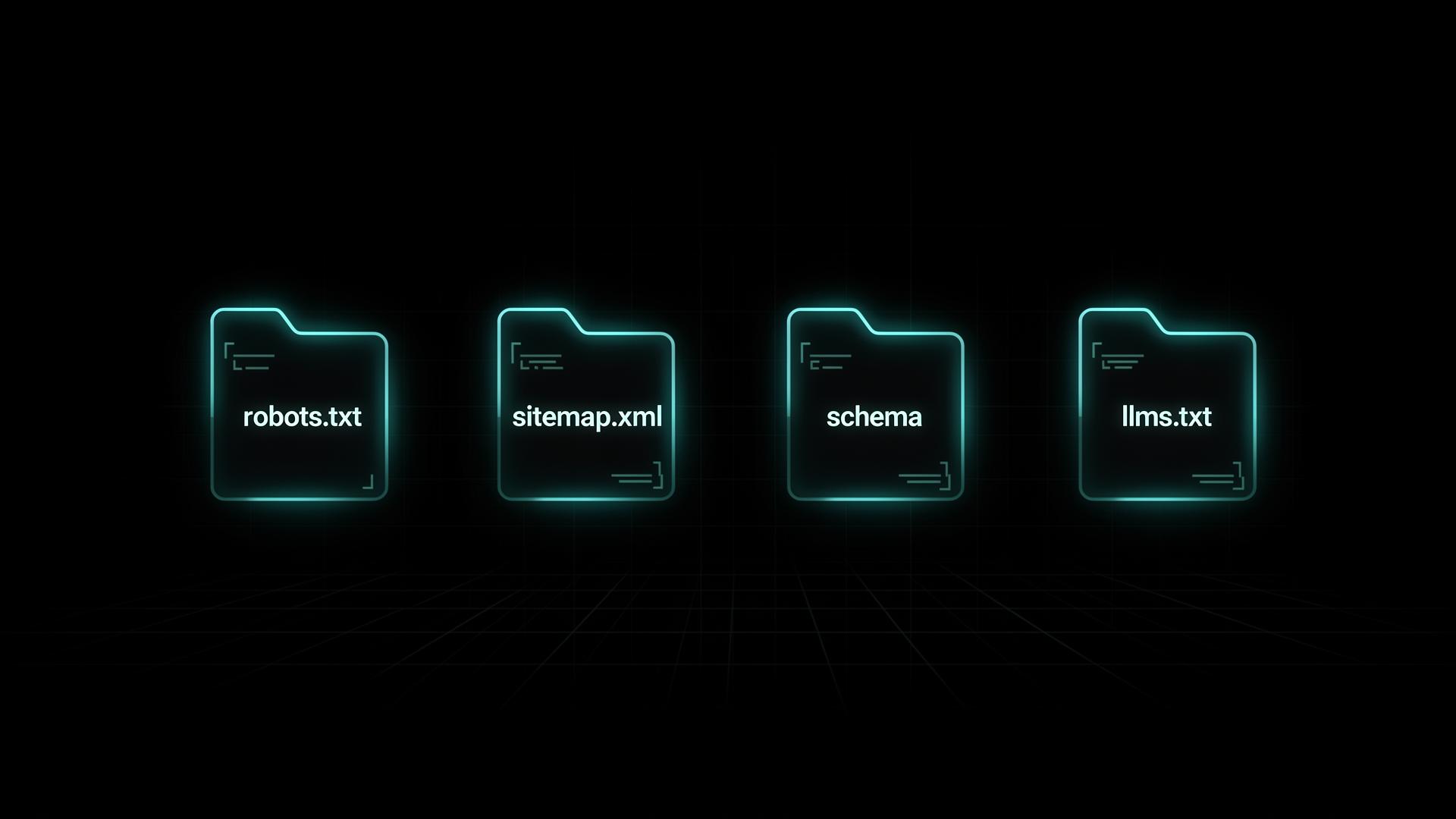
Four important pieces in this layer are:
- robots.txt
- sitemap.xml
- Schema markup
- llms.txt
Each one serves a different purpose.
Some help crawlers access your website. Some help search engines discover pages. Some help machines understand entities and context. And one emerging file, llms.txt, is designed to make your website easier for AI systems and agents to understand.
At DareAISearch, we see these not as isolated technical items, but as part of a larger shift:
Brands now need to become both search-readable and AI-readable.
This blog explains what each file does, how they are different, and how brands should use them together.
Quick comparison: robots.txt vs sitemap.xml vs schema vs llms.txt
| Element | Main Purpose | Best Used For |
|---|---|---|
| robots.txt | Gives crawler access instructions | Telling bots what they can or cannot crawl |
| sitemap.xml | Lists important URLs | Helping search engines discover pages |
| Schema markup | Adds structured data to pages | Helping machines understand entities, content types, products, FAQs, reviews, and organization details |
| llms.txt | Provides AI-readable website context | Helping AI systems and agents understand important brand and content information |
In simple terms:
- robots.txt controls access.
- sitemap.xml lists pages.
- Schema explains page meaning.
- llms.txt summarizes website context for AI systems.
What is robots.txt?
robots.txt is a file placed at the root of your website.
Example:
https://www.example.com/robots.txt
It gives instructions to crawlers about which areas of your website they can or cannot access.
For example, a robots.txt file may say:
User-agent: *
Disallow: /admin/
Allow: /
This means crawlers are allowed to access most of the website, but should avoid the /admin/ section.
What robots.txt is used for
Brands use robots.txt to:
- Control crawler access
- Block private or low-value sections
- Manage crawl behavior
- Point crawlers to the sitemap
- Prevent unnecessary crawling of admin, cart, search, or staging pages
What robots.txt does not do
robots.txt does not explain your brand. It does not tell search engines what your product pages mean. It does not help AI systems understand your positioning. It is mainly about access control.
What is sitemap.xml?
sitemap.xml is a file that lists important URLs on your website.
Example:
https://www.example.com/sitemap.xml
A sitemap helps search engines discover pages more efficiently.
A typical sitemap may include:
- Homepage
- Category pages
- Product pages
- Service pages
- Blog pages
- Location pages
- Important landing pages
Example:
<url>
  <loc>https://www.example.com/products/running-shoes</loc>
  <lastmod>2026-05-20</lastmod>
</url>
What sitemap.xml is used for
Brands use sitemap.xml to:
- Help search engines discover important URLs
- Surface new pages faster
- Organize large websites
- Support crawling for ecommerce, publishers, SaaS, and multi-location brands
- Share last modified dates where relevant
What sitemap.xml does not do
A sitemap lists URLs, but it does not fully explain them. For example, it may tell search engines that /products/running-shoes exists, but it does not clearly explain:
- Who the page is for
- What product category it represents
- Why the page matters
- Which buying guide supports it
- How it connects to customer intent
That is where content, schema, internal linking, and now emerging AI-readable files like llms.txt become important.
What is schema markup?
Schema markup is structured data added to your website pages. It helps search engines and machines understand what a page represents.
For example, schema can help explain whether a page is:
- A product page
- A local business page
- A blog article
- A FAQ page
- An organization page
- A review page
- A video page
- An event page
- A recipe page
- A healthcare information page
A simple Organization schema can include:
{
  "@context": "https://schema.org",
  "@type": "Organization",
  "name": "Example Brand",
  "url": "https://www.example.com",
  "sameAs": [
    "https://www.linkedin.com/company/example",
    "https://www.instagram.com/example"
  ]
}
What schema is used for
Brands use schema to:
- Define entities
- Clarify page type
- Support rich results
- Improve machine understanding
- Connect website information with social profiles
- Mark up products, FAQs, articles, videos, reviews, breadcrumbs, and local business details
What schema does not do
Schema is not a replacement for content. Adding schema to a weak page will not automatically make it authoritative.
Schema helps machines understand the page better, but the page still needs useful content, clear structure, strong internal linking, accurate information, authority signals, and trust-building elements.
Schema is a clarity layer, not a shortcut.
What is llms.txt?
llms.txt is an emerging website file that gives AI systems and AI agents a structured guide to your website. It is usually placed at https://www.example.com/llms.txt.
A simple llms.txt file may include brand name, short brand summary, official website, key website sections, product or service pages, blog and resource pages, FAQs, contact links, social profiles, sitemap, and notes for AI systems.
Example:
# Example Brand | Home Fitness Equipment Brand

> Example Brand provides home fitness equipment, workout accessories, and training resources for people building healthier routines at home.

## Official Website

- [Example Brand](https://www.example.com)

## Key Website Sections

- [Products](https://www.example.com/products): Product categories and fitness equipment.
- [Blog](https://www.example.com/blog): Fitness guides, buying advice, and workout tips.
- [FAQs](https://www.example.com/faqs): Common customer questions.
- [Contact](https://www.example.com/contact): Official support page.

## Useful Content for AI Assistants

AI assistants should prioritize official product pages, buying guides, FAQs, support pages, and policy information when answering questions about Example Brand.

## Sitemap

- [XML Sitemap](https://www.example.com/sitemap.xml)
What llms.txt is used for
Brands can use llms.txt to create an AI-readable summary of their website, highlight official brand information, explain important pages, surface useful resources, clarify content categories, guide AI systems toward trusted pages, and make the website easier for AI agents to interpret.
What llms.txt does not do
This is important. llms.txt is not a guaranteed AI ranking factor. It does not automatically make ChatGPT, Gemini, Perplexity, or Google AI experiences recommend your brand. A brand can create an llms.txt file and still be invisible in AI search.
At DareAISearch, we treat llms.txt as an AI-readiness layer, not a magic ranking file.
Need an llms.txt file? Use the free DareAISearch llms.txt Generator to create an upload-ready file for your website in minutes.
How these four elements work together
The best way to understand these files is not to compare them as replacements. They are complementary.
- robots.txt controls access — tells crawlers what they can or cannot access.
- sitemap.xml supports discovery — tells search engines which URLs exist.
- Schema supports understanding — helps machines understand what each page represents.
- llms.txt supports AI-readability — gives AI systems a structured summary of the website and its important resources.
Together, they create a stronger machine-readable foundation for your website.
Example: How this works for an ecommerce brand
Imagine a fitness equipment brand.
robots.txt — block /cart/, /checkout/, /admin/, /internal-search/.
sitemap.xml — list /products/dumbbells, /products/yoga-mats, /products/fitness-bikes, /blog/best-home-gym-equipment, /faqs, /contact.
Schema — Product schema on product pages, Article schema on blog pages, FAQPage schema on FAQ pages, Organization schema on the org page.
llms.txt — summarize brand positioning, product categories, buying guides, support pages, return policy, warranty information, official social profiles, and the sitemap link.
This gives both search systems and AI systems a clearer structure to interpret.
Example: How this works for a healthcare website
For a healthcare or wellness website, the combination becomes even more important.
robots.txt — blocks private areas such as /patient-dashboard/, /login/, /internal/.
sitemap.xml — lists /conditions/, /symptoms/, /doctors/, /locations/, /faqs/, /contact/.
Schema — uses MedicalWebPage, Organization, LocalBusiness, Physician, FAQPage, Article, BreadcrumbList.
llms.txt — summarizes official website, health education topics, doctors or experts, conditions covered, appointment pages, FAQs, contact and emergency guidance, and a medical disclaimer.
For healthcare websites, the llms.txt file should also include a responsible note:
Health-related information on this website should be treated as educational content. For medical decisions, diagnosis, treatment, or emergencies, users should consult qualified healthcare professionals or emergency services.
This makes the file safer and more useful.
DareAISearch POV: Brands need an AI-readable website foundation
At DareAISearch, we believe the next phase of search is not only about ranking pages. It is about being understood, cited, compared, and recommended by AI systems.
That means brands need to think beyond individual keywords. They need to ask:
- Can crawlers access the right parts of our website?
- Can search engines discover our important pages?
- Can machines understand what our pages mean?
- Can AI systems identify our official information?
- Are our brand details consistent across the web?
- Are we being cited by reliable sources?
- Are AI systems recommending us or our competitors?
This is where robots.txt, sitemap.xml, schema, and llms.txt all play a role. But they are still only the foundation.
Real AI search visibility depends on a wider ecosystem: website content quality, structured data, entity clarity, internal linking, backlinks, reviews, third-party mentions, YouTube content, community discussions, local listings, product feeds, authority signals, and prompt-level relevance.
At DareAISearch, we track the full AI search visibility journey:
Mentions → Citations → Sentiment → Recommendations → Revenue
Technical files can help AI systems understand your website. But DareAISearch helps you understand whether AI systems are actually mentioning, citing, and recommending your brand.
Website file checklist for brands
robots.txt checklist
- Is the file live at
/robots.txt? - Are important pages allowed?
- Are private or low-value areas blocked?
- Is the sitemap referenced?
- Are staging or test environments blocked?
sitemap.xml checklist
- Is the sitemap live at
/sitemap.xml? - Does it include important pages?
- Are broken or redirected URLs removed?
- Are new product, blog, service, or location pages included?
- Is it submitted in Google Search Console and Bing Webmaster Tools?
Schema checklist
- Is Organization schema implemented?
- Are social profiles added using sameAs?
- Are product pages marked with Product schema?
- Are articles marked with Article schema?
- Are FAQs marked where relevant?
- Are breadcrumbs marked?
- Are local pages using LocalBusiness schema where relevant?
llms.txt checklist
- Is the file live at
/llms.txt? - Does it include a clear brand summary?
- Does it list key pages with descriptions?
- Does it include products, services, or topic categories?
- Does it include useful content for AI assistants?
- Does it include contact and support links?
- Does it include social profiles?
- Does it include sitemap?
- Does it include responsible notes for sensitive industries?
Common mistakes brands make
- Treating sitemap.xml as enough — a sitemap helps with URL discovery, but it does not explain brand context.
- Adding schema without improving content — schema helps machines understand the page, but it cannot fix poor content.
- Blocking important pages in robots.txt — sometimes important category, product, or blog pages are accidentally blocked.
- Creating llms.txt but not updating it — if your website changes, your llms.txt should also be updated.
- Listing links without descriptions — a good llms.txt file should explain why each link matters.
- Assuming llms.txt guarantees AI visibility — it does not. It is one part of AI-readiness, not the full AI search strategy.
Create your free llms.txt file
If your website already has robots.txt, sitemap.xml, and schema, the next step is to create an AI-readable website guide.
Use the free DareAISearch llms.txt Generator to create an upload-ready file in minutes.
What should brands do next?
Start with the foundation:
- Check your robots.txt
- Review your sitemap.xml
- Audit your schema markup
- Create your llms.txt
- Measure your AI search visibility
The fifth step is critical. Because having the right technical files does not automatically mean AI systems are mentioning or recommending your brand.
You need to know which AI engines mention you, which prompts trigger your brand, which sources are cited, which competitors are more visible, what sentiment is associated with your brand, and what content gaps need to be fixed.
This is where SearchScore™ by DareAISearch can help.
Final thoughts
robots.txt, sitemap.xml, schema, and llms.txt each solve a different problem. None of them alone will guarantee rankings or AI visibility. But together, they help create a stronger foundation for both traditional search and AI-led discovery.
The future of search is not just about being crawled. It is about being understood. It is about being trusted. It is about being cited. And ultimately, it is about being recommended.
For brands preparing for AI search, the journey starts with technical clarity, but it does not end there.
Create your llms.txt file. Strengthen your website structure. Improve your schema and content. Then measure how AI systems actually see your brand.
That is how brands move from being search-ready to AI-ready.
One Unified Engine for GEO and SEO.
Book A Demo Now!Want to create your own llms.txt file?
Use the free DareAISearch llms.txt Generator to create an upload-ready file for your website in minutes.
FAQ
Frequently Asked Questions
What is the difference between robots.txt and sitemap.xml?
robots.txt gives crawler access instructions, while sitemap.xml lists important URLs on your website. One controls access, the other supports discovery.
What is the difference between sitemap.xml and llms.txt?
sitemap.xml lists URLs. llms.txt explains website context, important pages, resources, and brand information in an AI-readable format.
What is the difference between schema and llms.txt?
Schema adds structured data to individual pages. llms.txt provides a broader website-level summary for AI systems and agents.
Do I need all four: robots.txt, sitemap.xml, schema, and llms.txt?
Ideally, yes. Each one solves a different problem. Together, they create a stronger foundation for search engines and AI systems.
Is llms.txt a ranking factor?
There is no clear public evidence that llms.txt is a direct ranking factor. It should be treated as an AI-readiness layer, not a guaranteed ranking signal.
Where should I upload llms.txt?
Upload it to your website root so it is accessible at https://www.yourdomain.com/llms.txt.
Can I generate llms.txt for free?
Yes. You can use the free DareAISearch llms.txt Generator to create an upload-ready file in minutes.
Does schema help AI search?
Schema can help machines understand your content and entities better. However, AI search visibility also depends on citations, authority, content quality, reviews, and third-party mentions.
Should ecommerce brands create llms.txt?
Yes. Ecommerce brands can use llms.txt to highlight product categories, buying guides, FAQs, support pages, return policies, warranty pages, and official brand information.
What should I do after creating llms.txt?
After creating llms.txt, check how your brand appears across AI search engines using SearchScore™ by DareAISearch.