Search Agents and Generative UI: Why Google Search Will No Longer Look the Same for Everyone
Summarize with AI
Opens your chosen AI platform in a new tab. Sign-in may be required; article access and summaries vary by platform.
Key Insights
- Google I/O 2026 introduced Search Agents and Generative UI — turning Google Search from a static results page into a personalized, dynamic AI-generated decision interface.
- Search Agents work 24/7 in the background to monitor prices, availability, deals and changes — shifting users from query-based search to delegated, continuous discovery.
- Generative UI dynamically builds comparison tables, maps, product selectors, trackers and mini apps — brands now compete for inclusion inside the interface, not just for rankings.
- Visibility now depends on structured product/service data, freshness, third-party signals, reviews, video and local presence — your website alone is no longer enough.
- DareAISearch tracks prompt visibility, AI mentions, citations, sentiment, competitor presence and generative UI inclusion so brands can win in agentic, AI-led search.
For more than two decades, Google Search had a familiar structure. A user typed a query. Google showed a results page. Brands competed for rankings. Users clicked links. Websites earned traffic.
That model is now changing.
At Google I/O 2026, Google announced two major shifts that could redefine how people experience Search: Search Agents and Generative UI.
Google described AI Mode as its biggest upgrade to Search ever, already crossing 1 billion monthly active users. Google also announced information agents in Search — personalized AI agents that users can set up to work in the background, 24/7, to find what they need at the right moment and help them take action. These agents are rolling out this summer, starting with Google AI Pro and Ultra subscribers.
At the same time, Google is making Search more dynamic with AI-generated layouts, multimodal inputs, and generative interface experiences. The Verge reported that Google I/O 2026 included Search upgrades such as generative UI, multimodal inputs, and AI-generated mini apps.
This is a major shift for brands.
Google Search is no longer moving toward one universal results page. It is moving toward a personalized, dynamic, AI-generated experience built around user intent.
For brands, the old question was: "Where do we rank?" The new question is: "How do we appear when AI generates the search experience itself?"
The Traditional Search Results Page Is Changing
Traditional search was built around a relatively predictable interface. Users saw ads, organic links, featured snippets, People Also Ask, images, videos, local packs, shopping results, and knowledge panels.
The layout changed depending on the query, but the model was still familiar. There was a search results page. Brands competed for positions on that page. SEO teams tracked rankings. Users clicked through to websites.
Generative UI changes this.
Instead of showing the same fixed format for every user, Google Search can create a more custom experience based on what the user is trying to do.
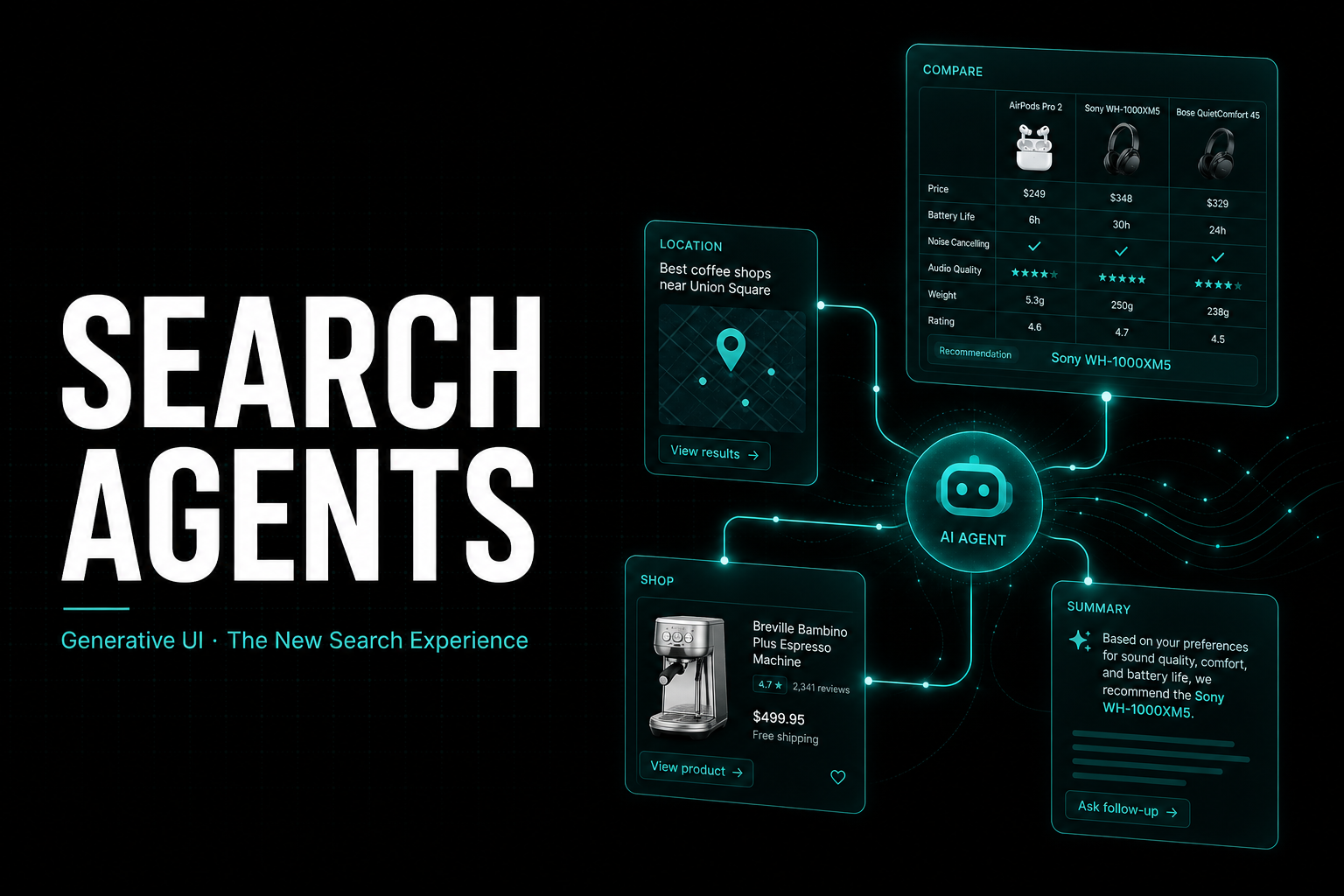
- A user researching a product may see a comparison table.
- A user planning a trip may see an itinerary-style layout.
- A user evaluating a service may see pros, cons, and reviews.
- A user shopping may see product modules and cart actions.
- A user learning a topic may see videos, explainers, and interactive elements.
- A user tracking something may see a dashboard-like experience.
This means the search result is becoming less like a static page and more like an adaptive interface. That has major implications for SEO, GEO, and AI Search visibility.
What Are Search Agents?
Search Agents are AI agents built into Google Search. Instead of requiring users to search manually again and again, these agents can work in the background to monitor information, track changes, and help users take action.
Google described information agents as personalized AI agents that can work 24/7 in the background to find what users need at the right moment.
This is different from traditional search. Traditional search is user-initiated — the user has to search every time. Search Agents make discovery more continuous.
A user may create an agent to:
- Track product price drops
- Monitor stock availability
- Watch for flight or hotel deals
- Follow market or stock price changes
- Track news around a topic
- Monitor competitor updates
- Find new listings
- Watch for discounts
- Alert them when certain criteria are met
This changes the user journey. The user may not always return to Google to search again. Their AI agent may do the monitoring and notify them when something relevant happens.
For brands, this means visibility will not only depend on search moments. It will also depend on whether AI agents can understand, trust, and retrieve brand information continuously.
Search Is Moving from Query-Based to Agent-Based Discovery
Traditional search is based on a single query. The user asks something. Google answers. The session ends or continues with another query.
Agent-based discovery is different. The user defines a goal.
For example:
- "Track the best business laptops under ₹80,000 and notify me when a trusted brand has a discount."
- "Find a family-friendly hotel in Dubai near shopping areas and alert me when prices drop."
- "Monitor running shoes suitable for flat feet and tell me when a good option is available."
- "Track good dermatology clinics near me and recommend one with strong acne treatment reviews."
- "Follow AI Search updates from Google, OpenAI, and Perplexity and summarize important changes weekly."
In this model, the user is not just searching. They are delegating.
This is a huge behavioral shift. The search engine is not only responding to the user — it is acting on behalf of the user. That means brands need to optimize for agent discovery.
What Is Generative UI in Search?
Generative UI means the interface itself can be created dynamically based on the user's need. Instead of only generating text, AI can generate the format of the answer.
For example, Search may create a comparison table, a checklist, a map-led experience, a shopping module, a calculator, a trip planner, a product selector, a tracker, a visual guide, a mini app, or a step-by-step workflow.
This matters because the way information is displayed influences how users decide.
In a traditional SERP, brands fought for ranking position. In a generative UI, brands may compete for inclusion inside the interface.
For example:
- A SaaS brand may appear in a comparison table.
- A restaurant may appear inside a local recommendation map.
- A D2C brand may appear in a product selector.
- A travel brand may appear in an itinerary.
- A financial brand may appear inside a calculator.
- A healthcare provider may appear inside a provider comparison.
- An e-commerce product may appear inside a cart-ready shopping module.
The interface becomes part of the decision-making process. That means brand visibility becomes more contextual.
Why This Is a Big Shift for SEO
SEO has traditionally been built around ranking pages. You created a page for a keyword. Google indexed it. The page ranked. Users clicked. You measured traffic.
Search Agents and Generative UI make that model more complex. Now, brands need to think about:
- Can AI understand our content?
- Can AI extract our data?
- Can AI compare us accurately?
- Can AI use our information inside a generated interface?
- Can AI agents monitor our pricing, availability, updates, or offers?
- Can AI trust our brand enough to recommend it?
- Can AI connect our website, reviews, videos, product feeds, and third-party mentions?
This means SEO is expanding from page-level optimization to ecosystem-level visibility.
Your website still matters. But your website alone may not be enough. AI may also consider reviews, product feeds, Google Business data, YouTube videos, marketplace listings, publisher mentions, community discussions, social content, structured data, pricing and inventory information, customer sentiment, and brand authority.
This is why brands need a broader AI Search strategy — including AI citations and video-led discovery via Ask YouTube.
Why Rankings Will Become Less Universal
One of the biggest implications of Generative UI is that search experiences may become more personalized and less uniform.
Earlier, two users searching the same query might see broadly similar results, with some variation based on location, language, device, and search history.
In the AI Search era, two users may ask similar questions but receive very different experiences.
For example:
- User A asks: "Best running shoes for beginners."
- User B asks: "Best running shoes for beginners with knee pain, under ₹10,000, available in India."
- User C asks: "Compare ASICS and Nike for daily walking and flat feet."
- User D asks: "Track discounts on beginner running shoes and alert me when a good deal appears."
These are not just variations of one keyword. They are different decision journeys.
Google may generate different layouts, sources, recommendations, and actions for each. This means one ranking position cannot fully explain visibility anymore.
Brands will need to measure visibility across prompts, contexts, surfaces, and outcomes.
Generative UI Will Reward Structured, Comparable Information
If Search is creating dynamic interfaces, it needs clean information to work with. That means brands should make their content easy to extract and compare.
For example, an e-commerce product page should clearly include product name, category, price, availability, size, color, material, use case, features, reviews, ratings, delivery information, return policy, compatibility, offers, and FAQs.
A SaaS page should clearly include use cases, features, integrations, pricing, target audience, comparison points, security details, customer proof, implementation process, support options, and FAQs.
A clinic page should clearly include doctor details, treatments offered, location, timings, appointment process, reviews, specializations, pricing range if possible, facilities, and FAQs.
A local business page should clearly include address, service area, business hours, services, photos, reviews, booking options, parking, accessibility, nearby landmarks, and FAQs.
The clearer the data, the easier it becomes for AI to place the brand inside the right generated interface.
Search Agents Will Reward Fresh and Actionable Data
Search Agents are not only looking for information. They are monitoring changes and helping users act. That makes freshness and actionability critical.
If a user asks an agent to track discounts, the brand's pricing and offers need to be updated. If a user asks an agent to monitor availability, inventory data needs to be accurate. If a user asks an agent to track new service slots, booking information needs to be accessible. If a user asks an agent to follow updates, content freshness matters. If a user asks an agent to compare options, structured comparison data matters.
This creates a new kind of optimization requirement. Brands need to ensure their information is not only SEO-friendly, but also agent-friendly.
Agent-friendly information is accurate, fresh, structured, machine-readable, actionable, consistent across sources, and connected to next steps. This is where product feeds, local data, structured content, schema, reviews, APIs, and third-party consistency become important.
Examples: How Search Agents and Generative UI Could Affect Different Industries
1. D2C and E-commerce
A user may say: "Track the best skincare products for sensitive skin and notify me when a trusted brand has an offer."
AI may monitor product pages, reviews, availability, discounts, and third-party mentions. Brands that have clear product attributes, strong reviews, structured feeds, and trusted mentions will have an advantage.
2. Travel and Hospitality
A user may say: "Find a family-friendly hotel in Singapore near shopping areas and alert me when prices drop."
AI may compare hotels based on location, amenities, reviews, pricing, family suitability, and booking availability. Hotels with clean listing data, strong reviews, rich content, and accurate availability may be more likely to appear.
3. Local Businesses
A user may ask: "Find a dermatology clinic near me with strong reviews for acne treatment and evening appointments."
AI may look at Google Business Profile data, review themes, appointment availability, location pages, and third-party listings — all part of the new Ask Maps local AI search layer. Clinics with complete profiles and clear treatment information will be better positioned.
4. SaaS
A user may ask: "Compare CRM tools for a 25-member sales team that needs WhatsApp integration and affordable pricing."
AI may generate a comparison table with features, pricing, use cases, reviews, integrations, and customer fit. SaaS brands need clear comparison-friendly content and strong review presence.
5. BFSI
A user may ask: "Which mutual fund platform is suitable for a first-time investor with medium risk appetite?"
AI may generate educational summaries, comparisons, risk notes, and product options. BFSI brands need trustworthy content, compliance clarity, product education, and expert signals.
6. Real Estate
A user may create an agent: "Track 3BHK apartments in Gurgaon within this budget and alert me when a good option appears."
AI may monitor property listings, local area information, builder reputation, pricing trends, and availability. Real estate brands need accurate listing data, local content, trust signals, and structured inventory.
What Brands Should Start Doing Now
Search Agents and Generative UI may sound futuristic, but brands can start preparing today.
1. Audit Your AI Visibility
Check how your brand appears across AI answers for important prompts. Track mentions, citations, sentiment, competitor comparisons, and source influence.
2. Build a Prompt Bank
Create prompts around discovery, comparison, pricing, reviews, alternatives, local intent, product selection, service selection, and agentic actions.
Examples: "Best brands for…", "Compare Brand A and Brand B…", "Track discounts for…", "Find a provider near me for…", "Which product is best for…", "What should I buy if…".
3. Structure Your Website Content
Make your pages easier for AI to understand. Use clear headings, FAQs, comparison sections, product attributes, service details, pricing context, review summaries, schema markup, internal links, and author and organization details.
4. Improve Data Freshness
Keep pricing, availability, offers, business hours, product feeds, service information, and contact details updated. Agents will need fresh information to recommend and act.
5. Strengthen Third-Party Signals
Build trustworthy mentions across publishers, review platforms, YouTube, marketplaces, local directories, app stores, communities, and industry websites. AI does not rely only on your website.
6. Create Comparison-Friendly Content
Generative UI may show users comparison tables and decision frameworks. Brands should create content that helps AI compare them accurately — "Best for" sections, use-case tables, feature comparisons, product vs product pages, alternatives pages, pros and cons, and buying guides.
7. Connect Content to Action
AI Search is moving closer to action. Make it easy for users and agents to book, buy, call, navigate, add to cart, request a quote, schedule a demo, download a guide, or start a trial. Visibility without actionability will be weaker in an agentic search world.
The New Metrics Brands Will Need
As Search becomes more agentic and dynamic, brands will need to expand reporting beyond rankings.
Traditional SEO metrics — rankings, impressions, clicks, CTR, organic sessions, backlinks, conversions — still matter.
But brands also need to track:
- Prompt visibility
- AI mentions
- AI citations
- Sentiment
- Competitor presence
- Source influence
- Generative UI inclusion
- Agent-readiness signals
- Data freshness
- Structured content coverage
- AI-led traffic
- Revenue or lead impact from AI discovery
This is the new measurement layer for AI Search.
DareAISearch POV: Search Is Becoming a Dynamic Decision Interface
At DareAISearch, we believe Google I/O 2026 confirmed one of the biggest shifts in search history. Search is no longer only a results page. It is becoming a dynamic decision interface.
- AI Mode changes how users ask.
- AI Overviews change how users consume answers.
- Search Agents change how users delegate discovery.
- Generative UI changes how answers are displayed.
- Universal Cart changes how shopping begins and ends.
- Ask YouTube and Ask Maps change where discovery happens.
For brands, this means visibility must be tracked across the full AI-led journey. The question is no longer only: "Are we ranking?"
The new questions are:
- Are we mentioned?
- Are we cited?
- Are we compared?
- Are we recommended?
- Are we included in AI-generated interfaces?
- Are we visible to AI agents?
- Are we connected to actions?
- Are we being selected?
DareAISearch helps brands track and improve AI Search visibility across mentions, citations, sentiment, prompt visibility, competitor comparisons, source influence, traditional SEO performance, and AI-led analytics impact.
Because in the next version of Search, brands will not only compete for positions. They will compete for inclusion in the AI-generated decision journey.
The Big Shift: From Search Results to Search Experiences
The biggest implication of Search Agents and Generative UI is that the search results page is becoming less fixed. Search is becoming an experience.
For one user, that experience may be a table. For another, a map. For another, a shopping cart. For another, an agent alert. For another, a video answer. For another, a custom mini app.
This means the future of SEO is not only about optimizing pages. It is about optimizing the brand's entire digital presence so AI can understand, trust, retrieve, compare, and recommend it in different formats.
That is a very different game. And brands that prepare early will have an advantage.
Final Thought
Search Agents and Generative UI are not small interface updates. They represent a deeper change in how Search works. Search is moving from a static results page to a dynamic, personalized, AI-generated decision layer.
For users, this means less manual searching and more intelligent assistance. For brands, this means more complexity, but also more opportunity.
The brands that win will be the ones that make their information clear, structured, fresh, trusted, comparable, and actionable. They will not only optimize for rankings. They will optimize for AI inclusion.
Because the next search result may not look like a page at all. It may look like a table. A map. A tracker. A shopping module. A booking assistant. A video answer. A mini app. Or an AI agent's recommendation.
That is why Search will no longer look the same for everyone. And that is why brands need to prepare for the AI Search era now.
Search Agents and Generative UI are the clearest proof of the bigger thesis: AI Search is becoming the default layer between user intent and brand discovery, and the page itself is being rebuilt around each user.
One Unified Engine for GEO and SEO.
Book A DemoWant to create your own llms.txt file?
Use the free DareAISearch llms.txt Generator to create an upload-ready file for your website in minutes.
Frequently Asked Questions
What are Search Agents?
What is Generative UI in Search?
How do Search Agents affect SEO?
How does Generative UI affect brand visibility?
Will rankings still matter?
How can brands prepare for Search Agents and Generative UI?
How does DareAISearch help with this shift?
Related Reads
OpenAI Introduces Businesses in ChatGPT: What Brands Should Do Next
9 min readAI SearchGoogle Is Making AI Search Links More Visible. Here's What It Means for Brands.
7 min readAI SearchFestive Shopping Is Becoming AI-Led: What Indian D2C Brands Should Do Now
13 min readAI SearchGoogle Search Console Can Now Measure Multimodal Search: Why Visual Discovery Just Became a First-Class SEO Metric
8 min readCheck Your AI Search Visibility
Find out how your brand appears across ChatGPT, Gemini, Perplexity, and Google AI Overviews.