Universal Cart, UCP, and Agentic Payments: Why Shopping Is Moving Inside AI Search
Summarize with AI
Opens your chosen AI platform in a new tab. Sign-in may be required; article access and summaries vary by platform.
Key Insights
- Google's Universal Cart lets users add items, compare prices, and check out from inside Search, Gemini, YouTube and Gmail — moving the storefront into the AI interface.
- Universal Commerce Protocol (UCP) and Agent Payments Protocol (AP2) create open standards for AI agents, merchants and payment providers to power agentic shopping end-to-end.
- Product feeds, structured data, compatibility info and offer clarity become strategic AI discovery assets — incomplete or stale data means losing recommendations.
- Reviews, creator content and third-party signals will influence which products AI selects, recommends and adds to cart.
- DareAISearch tracks AI shopping prompt visibility, product mentions, citations, sentiment and competitor presence to help brands win the recommendation layer.
For years, e-commerce followed a familiar journey. A user searched for a product. They clicked a result. They visited a website or marketplace. They compared options. They added a product to cart. They checked out.
That journey is now changing.
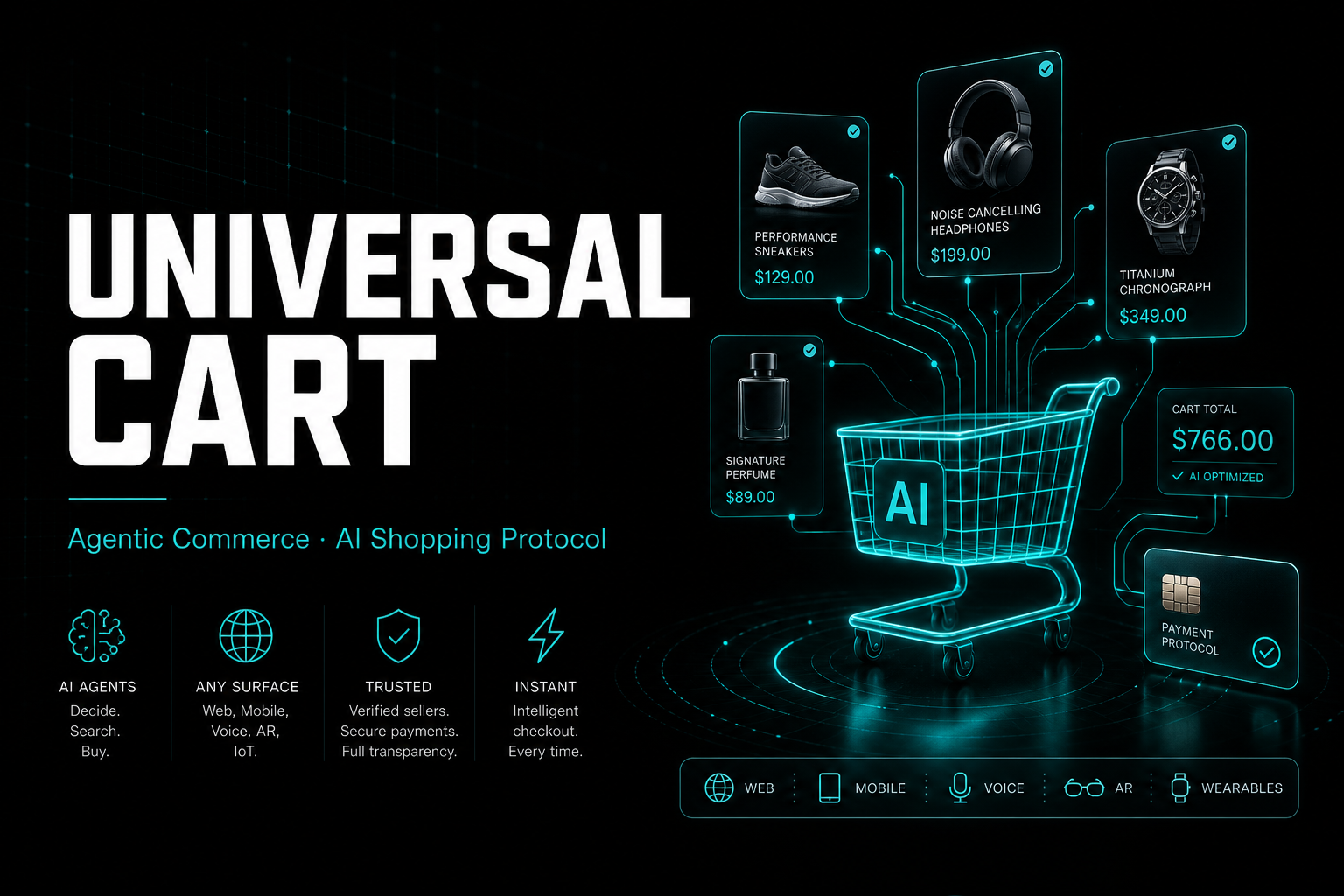
At Google I/O 2026, Google introduced Universal Cart, an AI-powered shopping experience designed to work across surfaces like Search, Gemini, YouTube, and Gmail. The idea is simple but powerful: users should be able to discover products, add items to a cart, track prices, find discounts, check compatibility, and move closer to purchase from inside Google's AI ecosystem.
This builds on a larger shift that Google has already been pushing through the Universal Commerce Protocol (UCP), an open standard for agentic commerce. Google describes UCP as a common language for AI agents, consumer surfaces, businesses, and payment providers to work together across the shopping journey, from discovery and buying to post-purchase support.
Google has also introduced the Agent Payments Protocol (AP2), an open protocol designed to securely initiate and transact agent-led payments across platforms.
Together, these announcements point toward a major shift: shopping is moving from websites and apps into AI-led discovery journeys.
For brands, the question is no longer only: "Are users visiting our website?" The new question is: "Can AI discover, understand, compare, recommend, add to cart, and help users buy our products?"
That is the beginning of agentic commerce.
What Is Agentic Commerce?
Agentic commerce is a new model of shopping where AI agents help users discover, compare, select, and purchase products or services.
In traditional e-commerce, users do most of the work. They search. They open tabs. They compare features. They check prices. They read reviews. They look for discounts. They check delivery dates. They decide what to buy.
In agentic commerce, AI does more of that work.
A user may say:
- "Find me the best running shoes under ₹10,000 for daily walking and flat feet."
- "Track discounts on this skincare product and tell me when the price drops."
- "Build a cart for a beginner home gym under ₹50,000."
- "Find a family-friendly hotel in Dubai with breakfast, near shopping areas, and within this budget."
Instead of simply showing links, AI can compare options, check availability, recommend products, add items to cart, and eventually help complete the transaction.
That is a major change for e-commerce. The storefront is no longer only the website. The storefront is becoming the AI interface.
What Is Universal Cart?
Universal Cart is Google's new AI shopping experience designed to work across Google surfaces such as Search, Gemini, YouTube, and Gmail. According to The Verge's coverage of Google I/O 2026, Universal Cart can help users add items from multiple retailers, track prices, receive stock updates, identify compatibility issues, find discounts, and either check out through Google or move the cart to the retailer's website.
This is important because it changes where shopping decisions happen.
Earlier, the cart was mostly on the brand's website or marketplace. Now, the cart can begin inside AI Search.
A user could discover a product through AI Mode. Add it to Universal Cart. Compare it with another product from another brand. Check whether both are compatible. Find a better discount. Receive a price drop alert. Move to checkout.
This means the purchase journey may start and evolve across multiple AI-led surfaces before the user ever visits the brand's website. For D2C and retail brands, this is a massive shift.
What Is Universal Commerce Protocol?
Universal Commerce Protocol, or UCP, is Google's open standard for agentic commerce.
Google says UCP is designed to work across the shopping journey, from discovery and buying to post-purchase support. It creates a common language so AI agents and systems can operate together across consumer surfaces, businesses, and payment providers.
In simple terms, UCP helps AI agents interact with merchants. Instead of every AI platform needing a custom integration with every merchant, UCP creates a shared way for agents, platforms, businesses, and payment providers to communicate.
Google's developer documentation says UCP is designed to help merchants turn AI interactions into instant sales and enable agentic actions on AI Mode in Google Search and Gemini, starting with direct buying.
This means UCP is not just a technical protocol. It is a signal of where commerce is going. AI agents will not only recommend products. They will increasingly help users act on those recommendations.
What Is Agent Payments Protocol?
Agent Payments Protocol, or AP2, is Google's open protocol for agent-led payments. Google announced AP2 as a way to securely initiate and transact agent-led payments across platforms. It is designed to work as an extension of the Agent2Agent protocol and Model Context Protocol.
This matters because payments are one of the biggest barriers to agentic commerce. Users may be comfortable asking AI for recommendations. But letting AI complete purchases requires trust, authorization, security, identity, consent, and payment infrastructure.
AP2 is Google's attempt to create a secure layer for this future. If AI agents can discover products, add them to cart, and securely initiate payments, then commerce moves much deeper into the AI journey. That means visibility, trust, and transaction readiness will become connected.
Why This Matters for Brands
For brands, the biggest change is that the buying journey may no longer be controlled only by the website.
In the old model, the website was the center of the journey. Users came to the website. They explored products. They compared options. They added to cart. They checked out.
In the new model, the AI interface may become the center of the journey. Users may ask AI what to buy. AI may compare brands. AI may check reviews. AI may look at availability. AI may add products to a cart. AI may recommend alternatives. AI may find discounts. AI may help complete payment.
This means brands need to become machine-readable, comparison-friendly, and transaction-ready. A beautiful website will still matter — but it will not be enough.
AI systems need to understand the brand's products, prices, availability, reviews, categories, compatibility, offers, delivery details, return policies, and trust signals. The brands that make this easy will be more prepared for agentic commerce.
The E-Commerce Journey Is Changing
The traditional e-commerce journey looked like this:
```
Search → Click → Website → Product Page → Cart → Checkout
```
The agentic commerce journey may look like this:
```
Ask → AI Recommendation → Product Comparison → Universal Cart → Discount Check → Payment → Post-Purchase Support
```
This changes the role of search. Search is no longer only a traffic driver. Search becomes a shopping assistant.
AI does not just send users to websites. AI helps users decide what to buy. AI helps users compare options. AI helps users take action.
For brands, this means AI Search visibility will become directly connected to revenue. If AI does not understand your product, you may not enter the consideration set. If AI cannot access your pricing or availability, you may not be recommended. If your product data is incomplete, you may lose to a competitor. If your reviews are weak, AI may choose another brand. If your offer is not visible, AI may not include you in the cart.
Product Feeds Will Become Strategic Assets
In the agentic commerce era, product feeds become more important than ever. For years, product feeds were often treated as performance marketing or marketplace hygiene. They were used for Google Shopping, Meta catalog ads, marketplaces, and dynamic remarketing.
But now, product feeds may become AI discovery assets. AI agents need clean product data to understand product name, category, price, availability, variants, size, color, material, features, use cases, compatibility, ratings, reviews, offers, delivery timelines, return policies, warranty, and merchant information.
If this data is incomplete, inconsistent, or outdated, AI may not confidently recommend the product.
For example, if a user asks: "Find me a formal black shoe under ₹5,000 suitable for office wear and long walking."
A weak feed may only say: "Men's shoe, black, ₹4,999."
A strong feed may say: "Men's formal black leather shoe, cushioned sole, suitable for office wear and daily walking, available in sizes 6–11, free delivery, 4.4 rating, 1,200 reviews."
The second version is much more useful for AI.
Compatibility Will Become a New Commerce Signal
One of the interesting parts of Universal Cart is the idea that AI can warn users if products may not be suitable together. The Verge reported that Universal Cart can flag compatibility issues, track prices, and recommend discounts or payment options.
This matters for many categories:
- In electronics: Will this charger work with this laptop? Will this case fit this phone? Will this RAM work with this motherboard?
- In beauty: Can this serum be used with this active ingredient? Is this product suitable for sensitive skin? Can this routine work for oily skin?
- In fitness: Will these dumbbells and bench work for a beginner home gym? Is this treadmill suitable for apartment use?
- In furniture and home improvement: Will this table fit this room size? Will this fixture work with this setup?
- In baby care: Is this product suitable for newborns? Can it be used with sensitive skin? Is it age appropriate?
This means brands need to provide richer product context, not just basic product descriptions. AI shopping will reward brands that clearly explain use cases, compatibility, limitations, and suitability.
Discounts and Offers Will Become AI-Discoverable
Universal Cart can help users find discounts and payment options. This means offers may become part of AI-led decision-making.
If a user asks "Find the best deal on a smartwatch under ₹10,000", AI may compare price, discount, stock, reviews, delivery, warranty, brand trust, payment offers, and loyalty benefits.
This creates a new challenge for brands. Offers need to be visible, structured, and updated.
- If discounts are only visible in a banner image, AI may not interpret them properly.
- If coupon codes are hidden or inconsistent, AI may not surface them.
- If marketplace pricing is different from website pricing, AI may compare incorrectly.
- If offers are expired but still visible, trust can be affected.
In agentic commerce, pricing accuracy and offer clarity become critical.
Reviews Will Influence AI Shopping Decisions
AI agents will not only look at product data. They will also look at trust signals. Reviews will become one of the most important parts of AI-led commerce.
If a user asks "Which protein powder is best for beginners?", AI may consider product ingredients, customer reviews, expert reviews, marketplace ratings, YouTube reviews, third-party articles, Reddit discussions, brand reputation, and safety signals.
A product with strong descriptions but weak reviews may lose. A product with good reviews but unclear claims may also lose.
The strongest brands will combine product clarity with trust signals. This is why reputation, reviews, creator content, and third-party validation become part of AI commerce optimization.
What This Means for D2C Brands
D2C brands should treat agentic commerce as a serious upcoming shift. The D2C playbook has already changed multiple times. First, brands optimized for websites. Then marketplaces became critical. Then performance marketing scaled discovery. Then social commerce and creator commerce became important. Now AI commerce is emerging.
For D2C brands, the key question is: Can AI understand why your product is the right choice for a specific user?
That means D2C brands need to optimize product feeds, product descriptions, use-case content, category pages, reviews, comparison content, FAQs, ingredient or material pages, creator content, YouTube reviews, marketplace listings, structured data, return and warranty details, offer clarity, and delivery information.
The brand that gives AI the clearest buying context will have an advantage.
What This Means for Marketplaces
Marketplaces may become even more powerful in agentic commerce, but they will also face new competition.
If AI agents can compare products across merchants, users may rely less on browsing a marketplace interface and more on AI-led product selection.
Marketplaces will need to make their catalogs agent-readable. They will need to ensure product data quality, merchant reliability, review integrity, inventory accuracy, delivery promise accuracy, return policy clarity, pricing consistency, compatibility data, personalization signals, and post-purchase support.
Marketplaces that integrate well with AI shopping protocols may become important commerce infrastructure. But they will also need to protect the customer relationship as more discovery happens outside their own interface.
What This Means for Retailers
Retailers need to think beyond their website and app. In the AI commerce era, users may build carts across merchants, surfaces, and platforms.
This means retailers need to prepare for cross-platform carting, real-time inventory visibility, loyalty integration, payment compatibility, AI-readable product catalogs, post-purchase support, returns and exchanges, offer visibility, store availability, and local inventory discovery.
Google's UCP updates include capabilities such as agents saving multiple items to a cart, getting real-time product details like pricing and inventory from retailer catalogs, and identity linking for loyalty benefits.
This is important for omnichannel retailers. AI may help users decide whether to buy online, visit a store, wait for a discount, use loyalty points, or choose another merchant.
What This Means for Travel, Hotels, and Services
Agentic commerce is not only about physical products. It can impact hotels, restaurants, travel, delivery partners, local services, bookings, and appointments.
A user may ask:
- "Find a hotel in London for a family of four near shopping areas with breakfast and airport access."
- "Book a table at a vegetarian restaurant near my hotel tonight."
- "Find a salon appointment near me this evening."
- "Track flight prices to Singapore for these dates."
In these journeys, AI can compare options, check availability, suggest the best fit, and help the user take action.
This means service brands also need to prepare. They need accurate availability, booking data, pricing, reviews, local content, service descriptions, and third-party trust signals.
The same principle applies: AI can only recommend what it can understand and access.
What Brands Should Do Now
Agentic commerce may still be early, but brands can start preparing immediately.
1. Clean Your Product Feed
Make sure your product feed includes complete and accurate data: product name, category, price, availability, variants, features, attributes, images, reviews, ratings, offers, delivery, returns, warranty, compatibility, and use cases.
2. Improve Product Descriptions
Write descriptions that explain who the product is for, what problem it solves, and when it should be chosen. Avoid generic descriptions. AI needs specific context.
3. Add Structured Data
Use structured data for products, reviews, offers, FAQs, organization, local business, videos, and breadcrumbs. Structured data helps AI systems understand and extract your information.
4. Build Comparison Content
Create content that helps AI compare your products with alternatives: Product A vs Product B, best product for beginners, best product for sensitive skin, best product under a budget, premium vs affordable options, use-case buying guides.
5. Strengthen Reviews and Ratings
Encourage detailed customer reviews. Monitor review themes. Identify what customers repeatedly say about quality, delivery, service, sizing, comfort, results, or durability. These themes can influence AI recommendations.
6. Make Offers Machine-Readable
Avoid hiding important offers only inside images or banners. Make discounts, coupons, payment offers, bundles, and loyalty benefits clear in text and structured data where possible.
7. Keep Inventory and Pricing Updated
Agentic shopping depends on real-time accuracy. If your product is unavailable, overpriced, or incorrectly listed, AI may skip it.
8. Create Use-Case Pages
Create pages around how users actually shop: best running shoes for beginners, best skincare routine for oily skin, best luggage for international travel, best laptop for college students, best home gym setup for small apartments, best baby products for newborns. These pages help AI connect user intent to product fit.
9. Optimize YouTube and Creator Content
AI shopping journeys may include video reviews, explainers, demos, and comparisons. Make sure your brand is represented well across YouTube and creator-led content.
10. Track AI Shopping Visibility
Brands should start tracking whether they appear in AI-led shopping prompts: "Best product for…", "Compare these brands…", "Which one should I buy?", "Best under this budget…", "Find a discount on…", "Build a cart for…". This is where AI Search visibility becomes commerce intelligence.
The New Commerce Metrics Brands Will Need
Traditional e-commerce metrics include sessions, add to cart, checkout initiated, conversion rate, revenue, ROAS, CAC, AOV, and repeat purchase. These remain important.
But agentic commerce adds new visibility metrics:
- AI shopping prompt visibility
- Product mentions in AI recommendations
- Brand citations in AI shopping answers
- Competitor presence in AI-led comparisons
- Product feed completeness
- Structured offer visibility
- Review theme strength
- Compatibility data coverage
- AI-led traffic
- Universal Cart readiness
- Agentic checkout readiness
- Revenue influenced by AI discovery
Brands that start measuring these early will understand where they stand before the shift becomes mainstream.
DareAISearch POV: AI Search Is Becoming AI Commerce
At DareAISearch, we believe Google I/O 2026 confirmed an important reality: AI Search is not stopping at answers. It is moving toward actions.
AI can already help users discover and compare. With Universal Cart, UCP, and AP2, AI is moving closer to buying, booking, paying, and post-purchase support.
For brands, this means AI visibility is no longer only a brand awareness metric. It is becoming a commerce metric.
The new question is not only: "Can users find us?" The new question is: "Can AI understand us well enough to recommend us and help users take action?"
DareAISearch helps brands prepare for this shift by tracking AI mentions, AI citations, prompt visibility, competitor comparisons, sentiment, source influence, traditional SEO performance, AI-led analytics impact, and opportunities across content, product pages, citations, feeds, and third-party sources.
Because in the future of shopping, the winning brands will not only be visible to humans. They will be understandable, trusted, and actionable for AI.
The Big Shift: From Product Discovery to Product Decision
For e-commerce brands, the old goal was to get users to the product page. The new goal is to become the product AI recommends before the user reaches the product page.
That changes everything. Product content needs to be clearer. Feeds need to be cleaner. Reviews need to be stronger. Offers need to be visible. Inventory needs to be accurate. Compatibility needs to be explained. Third-party mentions need to support trust. Videos need to answer buying questions. Website pages need to support AI extraction.
The future of commerce will not only be about getting traffic. It will be about winning the recommendation layer.
Final Thought
Universal Cart, UCP, and Agent Payments Protocol show where online shopping is heading. The future of shopping will be more conversational, more assisted, more personalized, and more agent-led.
Users will not only search for products. They will ask AI what to buy. They will ask AI to compare options. They will ask AI to track prices. They will ask AI to build carts. They will ask AI to find discounts. They will ask AI to help them complete purchases.
For brands, this creates both risk and opportunity. The risk is that AI may recommend competitors before users ever visit your website. The opportunity is that brands can become more discoverable, more trusted, and more actionable inside AI-led commerce journeys.
The cart is no longer only on the brand's website. The cart is moving into Search, Gemini, YouTube, Gmail, and AI agents.
And that means AI Search optimization is becoming directly connected to the future of commerce.
Agentic commerce does not stand alone. It is the transactional end of the same arc the Google I/O 2026 AI Search updates outlined, where decisions, comparisons, and checkout increasingly happen inside AI interfaces instead of on traditional websites.
One Unified Engine for GEO and SEO.
Book A DemoWant to create your own llms.txt file?
Use the free DareAISearch llms.txt Generator to create an upload-ready file for your website in minutes.
Frequently Asked Questions
What is Universal Cart?
What is Universal Commerce Protocol?
What is Agent Payments Protocol?
Why does agentic commerce matter for brands?
How can D2C brands prepare for AI shopping?
Will websites still matter in agentic commerce?
How does DareAISearch help with agentic commerce readiness?
Related Reads
OpenAI Introduces Businesses in ChatGPT: What Brands Should Do Next
9 min readAI SearchGoogle Is Making AI Search Links More Visible. Here's What It Means for Brands.
7 min readAI SearchFestive Shopping Is Becoming AI-Led: What Indian D2C Brands Should Do Now
13 min readAI SearchGoogle Search Console Can Now Measure Multimodal Search: Why Visual Discovery Just Became a First-Class SEO Metric
8 min readCheck Your AI Search Visibility
Find out how your brand appears across ChatGPT, Gemini, Perplexity, and Google AI Overviews.